| Feature | AAVE | Compound | MakerDAO |
| Main features | Decentralized lending and deposits | Money market-based loans | Issuance of the DAI stablecoin |
| Supported assets | A wide range of cryptocurrencies and ERC-20 tokens | A limited number of assets (ETH, DAI, USDC, USDT, WBTC, etc.) | Mainly ETH, DAI, stablecoins, and WBTC |
| Interest rates | Dynamic, variable, and stable (switchable) | Variables determined algorithmically | Fixed Interest Rate (Stability Fee) |
| Max LTV | Up to 75% | Up to 75% | Up to 66% |
| Risk Management Model | Single-collateral model | Aggregate risk model (V2), single asset (V3) | Collateralized Debt Positions (CDP) |
| Liquidation system | Based on the Aave protocol | Liquidator-based (V2), protocol (V3) | The “keeper” system with Dutch auctions |
| Liquidation threshold | 80% | 85% | 150% |
| Penalty for liquidation | 5% | 8% | 13% |
| Return on Capital | High | Medium (V2), High (V3) | Medium |
| Unique features | Flash loans, Portal, Isolation Mode, E-Mode | cTokens, variable rates | DAI stablecoin, stability mechanism |
| Governance token | AAVE (staking + voting) | COMP (vote only) | MKR (community vote) |
| TVL (2024) | $11.9 billion | $2.048 billion | It generates over $313 million in annual revenue |
| Blockchain networks | 11 different networks | 6 blockchain networks | Mainly Ethereum |

AAVE


AAVE-USDT
Since yesterday -
+1.81 USD 2.49%
Last week -
+8.12 USD 12.24%
Last month -
-14.35 USD -16.16%
The chart shows the AAVE current price in the AAVE/USDC currency pair (current AAVE price USD). On the Kanga exchange, you can buy this cryptocurrency paired with a stablecoin and check what is the AAVE price today
VOLUME (24H)
10 349 248 USD
CAPITALIZATION
112 202 408 USD
PRICE ATH*
666.03 USD -88.83%
DATE ATH*
18.05.2021
*All Time High — historically the highest value.
The record indicates the price of cryptocurrency quoted in US dollars. Presenting the price in this manner does not confirm the availability of this pairing on the Kanga cryptocurrency exchange. On Kanga, you will find quotations for cryptocurrencies against USDT, a stablecoin pegged to the US dollar’s value.
What is AAVE crypto?
Aave is one of the most popular decentralized finance (DeFi) platforms for lending and borrowing cryptocurrencies. The project was launched in 2017 by Stani Kulechov as ETHLend and was rebranded as Aave in 2018 (which means “spirit” in Finnish – a symbol of openness and financial transparency).
In this comprehensive guide, we explain what the Aave protocol offers, discuss the use of its native cryptocurrency, AAVE, examine its price, show you how to buy your first tokens, and determine whether staking them is worthwhile.
Aave Protocol: What is the Aave Protocol?
Aave is a decentralized finance protocol (the Aave protocol) that operates using smart contracts on the Ethereum blockchain. It enables two core functions:
- depositing cryptocurrencies into liquidity pools (lending),
- and borrowing cryptocurrencies (borrowing).
How AAVE protocol works?
The entire system operates without banks or institutions – instead, users lend funds to one another via code encoded in smart contracts. Below are 5 key features that, in our opinion, best define what Aave is:
Lending: Users who want to earn interest on their cryptocurrencies can deposit their tokens (e.g., ETH, USDC, BTC, and many others) into the Aave liquidity pool. By depositing funds, they become lenders and receive so-called aTokens (e.g., aETH, aUSDC) in return, which represent their share in the pool. aTokens automatically accrue interest – this means the balance grows in real time, as the lender earns interest paid by borrowers
Borrowing: Individuals in need of capital can take out a loan from these pools, thereby becoming borrowers. To do so, they must first provide collateral in the form of another cryptocurrency. Aave requires overcollateralization – this means the value of the collateral must exceed the value of the loan (e.g., you provide $150 in collateral to borrow $100 in cryptocurrency). This mechanism protects the system against borrower default. If the value of the collateral falls below a certain threshold, automatic liquidation occurs – the collateral is sold to repay the loan.
Flash Loans: A unique feature for which Aave is renowned is the so-called flash loan – an unsecured loan that must be repaid within a single blockchain transaction. While this may sound paradoxical, in practice it enables advanced arbitrage and trading strategies. A user can take out a large loan, use the funds (e.g., for arbitrage between exchanges), and repay the loan immediately (within the same block). If they fail to repay, the entire transaction is reversed, so the risk to the pool is zero. Flash loans have made Aave famous as a very trader-friendly protocol, as they allow users to profit from price differences without equity, though they require technical knowledge to implement.
Aave Protocol’s Multi-Chain Capabilities: Although Aave started on Ethereum, the protocol now operates across multiple blockchains and scaling solutions. As part of Aave v3, versions have been launched on Polygon, Avalanche, Arbitrum, and Optimism, among others, allowing users to take out loans with lower transaction fees than on Ethereum. This enables Aave to expand its reach into various ecosystems while remaining one of the most interoperable DeFi projects.
Risk Management: The security of the Aave protocol is ensured by a number of mechanisms. In addition to “overcollateralization” and liquidations, Aave also integrates price oracles (Chainlink) that provide reliable asset price data, which prevents price manipulation that could affect loans. Aave’s smart contracts are regularly audited by security firms (including Trail of Bits, OpenZeppelin, and Certora) and are covered by a bug bounty program to identify any potential vulnerabilities.
Aave vs. other DeFi platforms
Uses of the AAVE cryptocurrency
Aave is not only a protocol but also a cryptocurrency of the same name (AAVE). It plays a key role in the ecosystem, and its uses extend beyond lending. Here are the main areas where the AAVE token is used:
- Governance: The AAVE token is used to govern the Aave protocol. AAVE holders can propose and vote on changes to system parameters (e.g., interest rates, the list of supported tokens, loan limits), as well as on the introduction of new features or protocol updates (Aave Improvement Proposals). As a result, Aave is governed under a DAO (Decentralized Autonomous Organization) model, meaning that the community decides on the direction of development.
- AAVE as a utility token: The AAVE token itself serves several utility functions within the ecosystem. In addition to governance and staking, it offers benefits such as fee discounts – users who hold or stake AAVE can access more favorable terms when taking out loans (e.g., lower interest rates through the so-called “discount strategy” for AAVE stakers). AAVE also serves as a reward in liquidity mining programs – by encouraging users to provide liquidity, the protocol rewards them with additional AAVE tokens, which increases decentralization and community engagement.
- Safety Module: Users can stake AAVE tokens in the Safety Module to enhance the protocol’s security and earn rewards. In the event of a shortfall, up to 30% of the staked tokens may be used to cover losses. More on this later in the article.
AAVE staking – how does it work and is it worth it?
Staking AAVE is a process in which holders of this cryptocurrency lock their AAVE tokens in the protocol to support its security, and in return receive a reward. This mechanism is called the Aave Safety Module. It functions like an insurance fund: if a shortfall event occurs – such as a serious attack or system insolvency – the locked AAVE tokens may be partially seized (a process known as “slashing”) and used to cover the protocol’s losses, thereby protecting other users.
The maximum scale of such a potential slashing is 30% of the staked funds – this is therefore a risk that the staker accepts in exchange for passive income.
Remember that you can also stake AAVE on Kanga Exchange:

Source: Kanga Exchange
People who stake AAVE receive rewards in the form of AAVE tokens (known as Safety Incentives). The protocol distributes a pool of new AAVE to stakers every day – currently about 1,100 AAVE per day, allocated proportionally based on stakers’ shares. This translates to an attractive rate of return. For example, at the beginning of 2025, the annual percentage yield (APY) from the Safety Module was approximately 7%.
The final APY depends on the total amount of AAVE staked (the more stakers, the lower the percentage rewards) and on the managers’ decisions regarding the size of the reward pool.
It is worth noting that Aave is constantly improving its staking mechanism – the planned Umbrella update is set to introduce, among other things, automatic slashing and the ability to stake other assets (e.g., aTokens) in exchange for yield.
AAVE Crypto Price and Market Analysis
AAVE is one of the 30 largest cryptocurrencies in an ecosystem comprising thousands of tokens. In addition to the AAVE token price, it’s worth paying attention to the other details.
Daily trading volumes exceed hundreds of millions of dollars, and its total market capitalization is over 16 billion zlotys.
AAVE crypto market outlook for 2026:
- AAVE current price: 74.44 USD
- Market capitalization: 112 202 408 USD
- Ranking among the largest cryptocurrencies: 29.
- Volume (24h): 10 349 248 USD
- Total supply and maximum supply: 16 million AAVE tokens
- Circulating supply: 15.16 million AAVE tokens
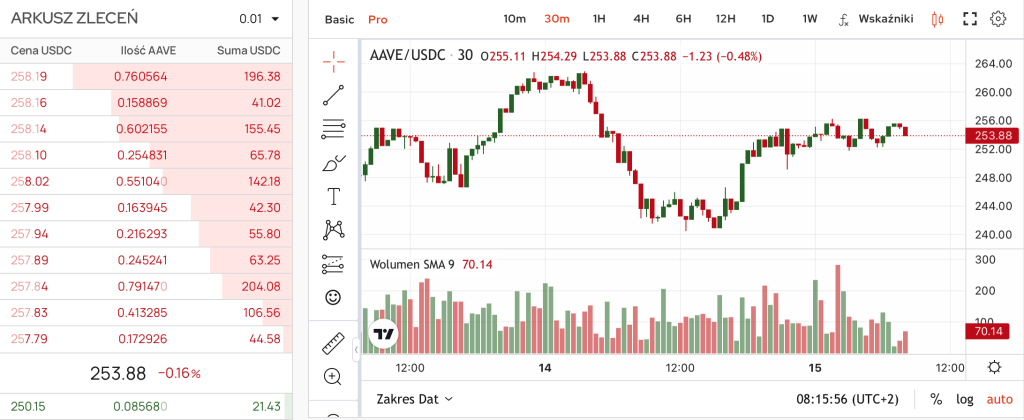
What is the current price of AAVE? Source: Kanga Exchange
Although AAVE hit its all-time highs during the 2021 bull market, when a single token was trading at nearly $680, investors certainly can’t complain about a lack of volatility right now. The price is a safe distance from its 2020 lows of just under $30 and is currently hovering near 3-year highs.
From a long-term technical analysis perspective, AAVE is currently in an uptrend, as suggested by, among other indicators, the 200-day exponential moving average (200 EMA). And although AAVE began 2025 with a correction, it has rebounded by nearly 150% from its April lows.
Where can I buy AAVE tokens and how to buy AAVE?
Are you looking for a place to buy Aave tokens? There are many options available, but one of the most convenient choices for Polish users is the Kanga Exchange.
Kanga is a Polish-based cryptocurrency platform supporting over 100 trading pairs, including popular stablecoins such as USDT, USDC, and DAI. The process of purchasing digital assets, including AAVE, is extremely simple:
Step 1: Account Registration and Verification
The first step is to create an account on the Kanga Exchange platform and complete the identity verification process. Verification is required in accordance with regulatory requirements and ensures the security of your transactions. You can find a detailed guide here.
Step 2: Deposit Funds
After successful verification, you must deposit funds into your account. Kanga Exchange offers various deposit methods, including: Bank transfers, BLIK (primarily for users in Poland), stablecoin deposits (USDC), and ZEN deposits.
Step 3: Find the AAVE token
Once your account is funded, you can go to the trading section and search for the AAVE token among the available financial instruments. The platform offers a search function that makes it easy to find a specific token.

AAVE is one of many tokens available on the Kanga exchange
Step 4: Completing the Transaction
There are two ways to buy AAVE:
- Market order – an immediate purchase at the current market price
- Limit order – a purchase at a price specified by the user
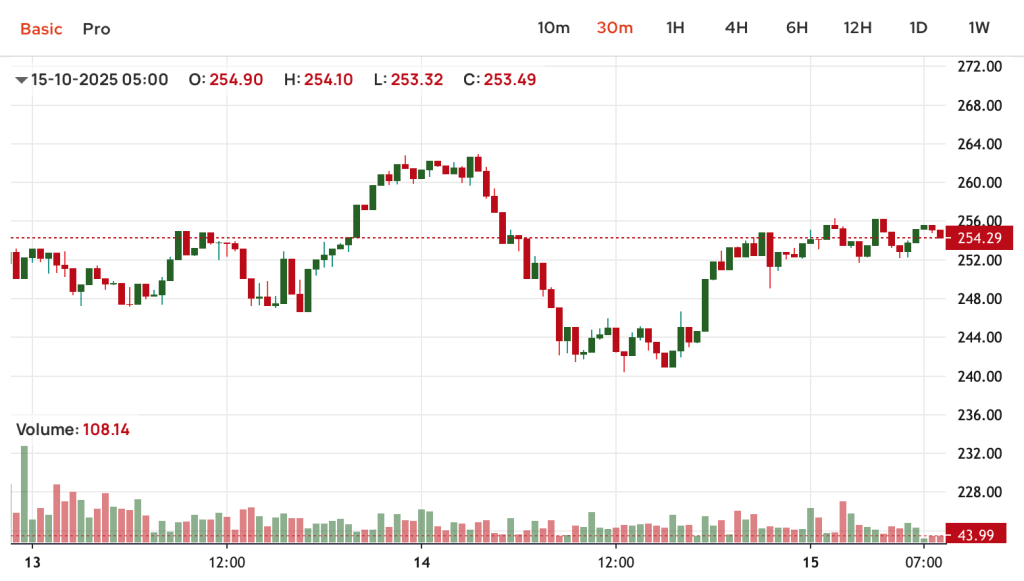
Buy AAVE Coin on Kanga Exchange. Also check the AAVE USDC exchange rate
Pros and Cons of Investing in AAVE
Investing in AAVE – like investing in any cryptocurrency – has its pros and cons. Below, we’ve compiled the key advantages and disadvantages of AAVE to help you determine whether AAVE is worth including in your portfolio.
| Pros of AAVE | Description | Cons of AAVE | Description |
| Leader in the DeFi sector | The largest lending protocol with a TVL of over $11 billion | High volatility | Price declines of 50–70% from their peaks |
| Continuous development | Flash loans, V3, GHO, new functions | Technical risk | Potential errors in smart contracts |
| Deflationary token | Limited supply of 16 million + buyback | Fierce competition | Compound, MakerDAO, new protocols |
| Staking rewards | A few percent per year from the Safety Module | Dependence on trends | Strong correlation with the crypto/DeFi market |
| The DAO Community | Decentralized vote management | Legal uncertainty | Lack of clear DeFi regulations |
| Safety | No major hacks, audits | Complexity | A barrier for new users |
AAVE is a token with significant growth potential tied to the development of decentralized finance, but it also carries substantial risks typical of innovative crypto projects. Is it worth investing in AAVE? That depends on your risk tolerance and your confidence in the future of DeFi. For decentralized finance enthusiasts, AAVE may be a must-have in their portfolio, while more conservative investors should consider diversifying their exposure appropriately and not exceeding a reasonable share of AAVE in their overall portfolio.
FAQ — AAVE crypto exchange rate
What is the current AAVE coin price, and where can I check it?
The AAVE price fluctuates constantly depending on market conditions. The easiest way to check the current price of AAVE cryptocurrency and view the chart is on Kanga Exchange: https://trade.kanga.exchange/market/AAVE-USDC
You can also check the actual AAVE market cap on the top of this page.
Where can I buy AAVE tokens?
AAVE is available on many cryptocurrency exchanges, including the largest global platforms. In Poland, you can buy AAVE on Kanga Exchange. Be sure to choose reputable exchanges with sufficient trading volume and robust security measures. You can check the actual price on the AAVE price chart.
What are the main uses of AAVE?
Aave primarily serves as a DeFi lending platform: it allows users to take out loans and lend to others in exchange for interest, in an automated and decentralized manner. With Aave, you can, for example, borrow stablecoins by pledging your BTC or ETH as collateral, or conversely, deposit stablecoins to earn interest from borrowers. In addition, Aave offers advanced features such as flash loans (used for arbitrage and other strategies), High Efficiency mode (eMode) to better utilize collateral with low-volatility assets, and a cross-chain portal (the ability to transfer Aave liquidity between different networks).
AAVE – is it worth investing in?
Investing in AAVE can be attractive if you believe in the continued growth of decentralized finance and the Aave protocol itself. This token provides exposure to one of the leaders in DeFi, which generates real revenue from fees and has an active community. The advantages of investing in AAVE include limited supply and deflationary mechanisms (buyback & burn), the ability to stake and earn passive income, and Aave’s key role in the ecosystem (which potentially means growing demand for the token as DeFi adoption increases).
How to store AAVE tokens after purchase?
You can store AAVE tokens in your own cryptocurrency wallet, which is the recommended option, or leave them on an exchange (which is less secure). It’s best to use a wallet that supports the ERC-20 standard. For maximum security, choose a hardware wallet such as Ledger or Trezor, where your private keys are stored offline.
What is the maximum supply of AAVE tokens?
The maximum supply of AAVE has been set at 16 million tokens. This entire supply was generated during the migration from the LEND token to AAVE, which took place in 2020 (a 100:1 conversion, where holders of 100 LEND tokens received 1 AAVE). At the time of Aave’s launch, some tokens went to LEND holders, some to the ecosystem treasury, and approximately 3 million AAVE were allocated to reserves (e.g., for future staking rewards). Currently, there are approximately 15.1 million AAVE in circulation, representing 94–95% of the total supply. Importantly, Aave has a burning mechanism: a certain percentage of the fees collected by the protocol is used to buy back AAVE from the market and burn it.
Who created Aave, and how long has the project been around?
Aave was created by Stani Kulechov, a Finnish programmer and entrepreneur. The project originally launched as ETHLend in 2017, an early P2P lending platform on Ethereum. During its ICO in November 2017, the team raised approximately $16.2 million for the project’s development. Due to liquidity issues in the P2P model, the decision was made to switch to a capital pool model and rebrand. In 2018, the name was changed to Aave, which means “spirit” in Finnish: the name symbolizes the invisibility and secure nature of the loans (without intermediaries).
How does Aave differ from other DeFi platforms, such as Compound or MakerDAO?
Aave, Compound, and Maker are the three pillars of DeFi, but each has its own unique characteristics. Aave vs. Compound: Both projects are lending protocols based on liquidity pools and overcollateralization. The differences? Aave has introduced more innovations (flash loans, efficiency mode, multi-chain). Compound initially focused only on Ethereum and simplicity, while Aave is expanding its list of supported assets and networks more quickly. Aave also lets you choose between variable and fixed interest rates, while Compound offers only variable rates. Aave vs MakerDAO: MakerDAO is a protocol for issuing the DAI stablecoin: loans are limited to DAI and are one-sided (you pledge cryptocurrency, you receive DAI). Aave, on the other hand, allows loans of many different tokens against a variety of collateral.
Can AAVE be staked, and how do I do it?
Yes, AAVE tokens can be staked in the Aave protocol via the Safety Module; Kanga Exchange also offers a staking option. Staking AAVE involves depositing your tokens into a special smart contract on the Aave website. In return, you receive stkAAVE tokens, which represent your staked shares.